Why Traditional Networking Doesn't Work for Everyone—And Why That's an Event Design Problem
- Jun 13
- 3 min read
I've never been good at networking.
Put me in a room with 300 people, a drink in one hand and a name tag on my jacket, and you'll probably find me standing on the sidelines, wondering how everyone else seems to make it look so easy.
I'm an introvert.
Walking up to strangers has always felt unnatural to me. Small talk drains me. The pressure to make a memorable first impression often has the opposite effect.
Yet give me a quiet table with four people and a conversation that goes beyond, "So, what do you do?" and I come alive.
Those are the moments I remember.
Those are the conversations that turn into relationships.
For years, I thought networking was simply a skill I needed to improve. Now I wonder if we've been designing networking events around the wrong idea altogether.
We assume connection happens because we put people in the same room.
It doesn't.
It happens when people feel comfortable enough to be themselves.
That's a very different experience.

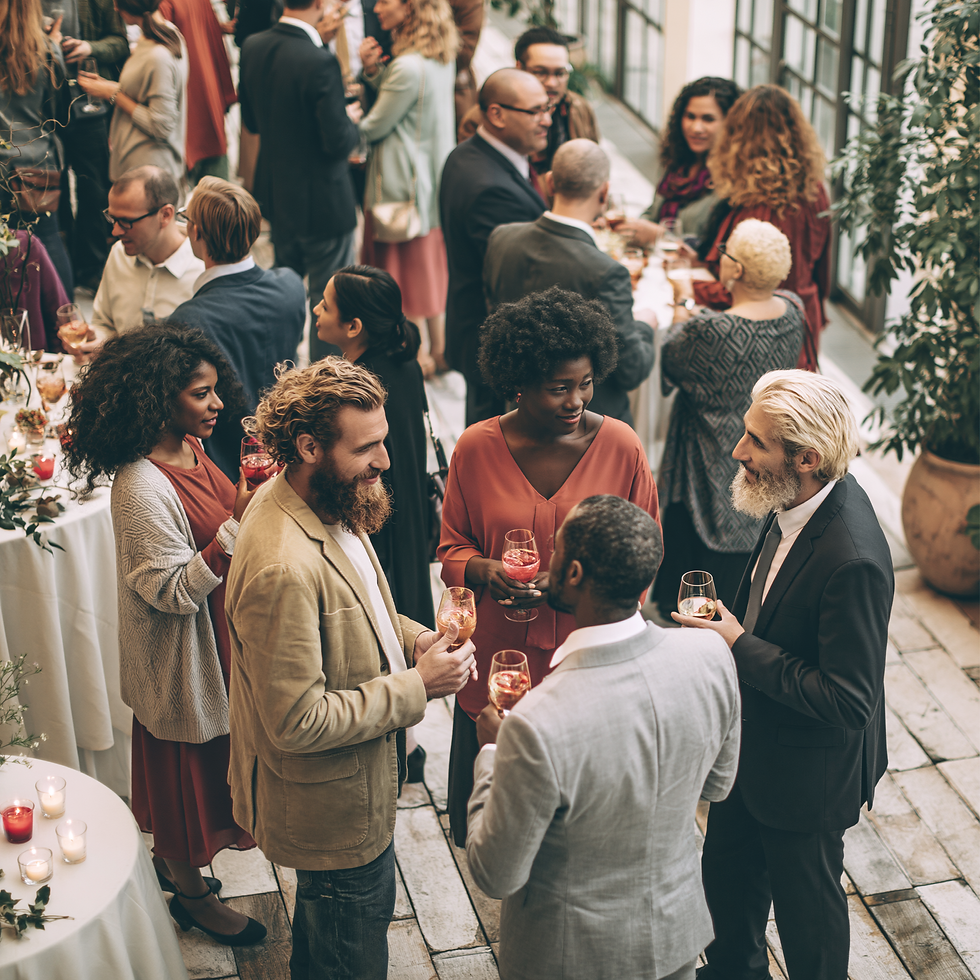
Too many traditional networking events still rely on the same formula: a crowded reception, background music loud enough to interrupt conversation that are difficult to hear, and an open invitation to "go network."
For some people, that's exciting.
For many others, it's exhausting.
The loudest voices fill the room while quieter personalities fade into the background. Not because they have less to offer, but because the environment rewards confidence over curiosity.
I have met some of the most thoughtful, creative and insightful people in small breakout conversations after an event has officially ended. When the crowd disappears, the masks come off. People stop performing and start connecting.
That makes me question whether the most valuable part of a networking event is the networking at all.
Perhaps what people are really looking for is belonging.
As someone who curates experiences, I spend a lot of time thinking about how environments shape human behaviour. We often focus on the visual elements of an event, but rarely ask how the space makes people feel.
Does it encourage conversation or competition?
Does it invite listening or self-promotion?
Does it create safety or social pressure?
These questions matter because human connection cannot be forced. It has to be invited.
Imagine replacing an hour of open networking with small, intentionally curated conversations where people gather around shared interests, challenges or ideas.
Imagine creating moments where titles disappear and stories take their place.
Imagine leaving an event remembering one conversation that changed your perspective instead of collecting twenty business cards you'll never use. That isn't a softer approach to networking.
It's a more human one.
As the world becomes more digitally connected, meaningful conversations become increasingly valuable. We can add thousands of people to our online networks with a click, yet many professionals still struggle to find a sense of genuine connection when they attend events.
That gap isn't a people problem.
It's a design problem.
The future of event experience isn't about creating bigger rooms or busier agendas. It's about creating spaces where different personalities can participate in ways that feel natural.
The extrovert shouldn't own the room.
The introvert shouldn't have to survive it.
The best gatherings leave people feeling heard, not just introduced.
Perhaps that's why the conversations I treasure most have never happened in the middle of a crowded ballroom. They've happened over coffee after the conference, in a quiet corner between sessions, a hallway, or around a table where no one was trying to impress anyone else.
Those moments stay with us because they remind us that relationships are built through presence, not performance.
Maybe it's time we stopped asking how to get people to network better.
Maybe we should start asking how to design events where meaningful connection can happen naturally.
I know which room I'd rather be in.
What if the most valuable connection at your next event isn't the one you planned for?
I'd love to hear your experience. Do you thrive in traditional networking environments, or do your most meaningful conversations happen in smaller, more intentional spaces? Share your thoughts in the comments or reach out—I'd love to continue the conversation.


Comments